Citizen Participation Discussed in International Webinar Organized by TCU and UNDP
By Secom / Serint
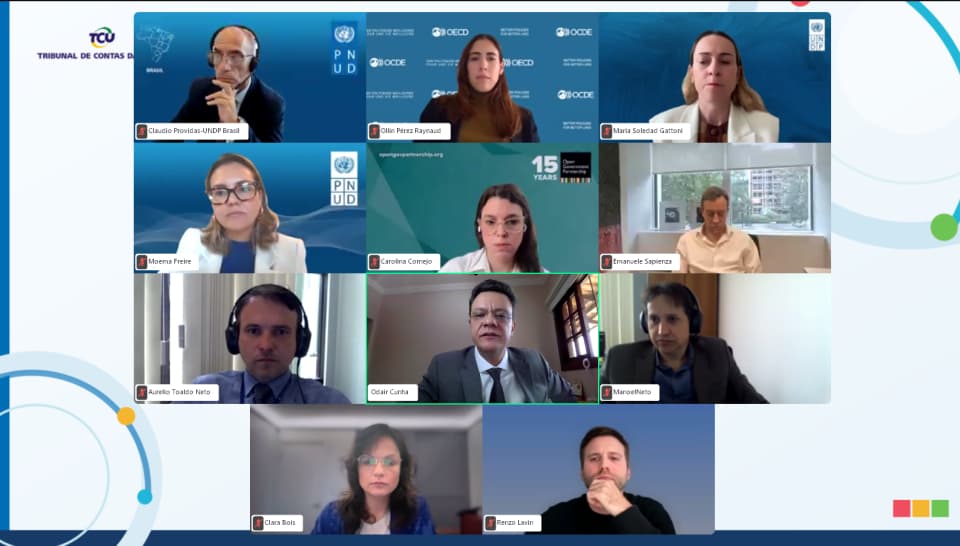
On September 17, the Brazilian Federal Court of Accounts (TCU), in partnership with UNDP Brazil and the UNDP Hub Center for Latin America and the Caribbean, hosted the international webinar "Citizen Participation in Audit Institutions". Broadcast via Zoom with simultaneous interpretation in Portuguese, Spanish, and English, the meeting brought together experts from Brazil and abroad to discuss the closer engagement between citizens and audit institutions and the expansion of social participation in monitoring public policies.
The program aimed to promote the exchange of practices that strengthen transparency, accountability, and trust in public institutions, also addressing topics such as open government experiences, social accountability, digital participation, inclusion, and opportunities for cooperation among organizations from different countries.
The event was moderated by Moema Freire, Regional Team Leader for Governance at the UNDP Regional Hub for Latin America and the Caribbean, and María Soledad Gattoni, Civic Engagement Policy Specialist with UNDP's Global Open and Inclusive Public Sphere Team.
The webinar was opened by TCU Minister Odair Cunha, who welcomed participants and expressed his appreciation for the partnership with UNDP. He emphasized that strengthening democracy necessarily depends on bringing citizens and public institutions closer together.
"We live in increasingly informed and connected societies. At the same time, more complex public challenges require institutions to enhance their ability to listen, dialog, and understand the diverse realities experienced by the population. For audit institutions, this agenda is of special importance. We oversee public resources, evaluate public policies, and contribute to the improvement of administration. Ultimately, however, this work exists to deliver results for society. Bringing citizens into government audit does not simply mean expanding social accountability, it also means strengthening our capacity to understand public problems, identify risks and priorities, and assess whether policies and services are, in fact, improving people's lives," the Minister stated.
TCU's Experience
Representing the Federal Court of Accounts, Aurelio Toaldo, head of the Citizen Participation Service from the Department of Institutional Relations, presented the TCU's Citizen Participation Framework, published in 2025. His presentation addressed the application of the framework and the lessons learned by the Court in audit processes, as well as in the two public consultations conducted through the Citizen Participation Portal and the Together for the Citizen Program.
According to Toaldo, citizen participation has already been incorporated into at least 100 TCU audits during 2025 and 2026. The initiative is part of the Court's efforts to expand public engagement in activities related to government audit and the improvement of public policies.
According to Ollin Pérez Raynaud, from the Organization for Economic Co-operation and Development (OECD), 43% of people in OECD countries declare that they have low or no trust in their national government. However, this level of trust tends to increase when citizens are involved in decision-making processes. "Those who feel they have a voice and can influence decisions express greater confidence in institutions. The issue is not simply participation, but better participation, with purpose and connection to results."
According to Carolina Cornejo, the Open Government Partnership (OGP) has promoted reference materials focused on citizen-centered initiatives, including the development of a guide for citizen participation within the strategy. She noted that, in recent years, the OGP and audit institutions have developed closer cooperation to encourage participatory audits. Carolina also emphasized that social participation does not undermine auditors independence but strengthens their performance.
Clara Bois, from People Powered, presented a guide on digital participation platforms and discussed three common myths surrounding such initiatives: that digital tools guarantee inclusion on their own; that the work ends once a participation channel is launched; and that more technological features necessarily mean better outcomes. According to the People Powered representative, what really makes a difference is having people within institutions who are trained to receive and respond to citizens contributions. "The digital tool is the last decision, not the first," she stated.
According to Renzo Lavin, an international consultant who shared lessons learned from experiences related to the World Bank and the Inter-American Development Bank (IDB), discussions on the suitability of citizen participation in oversight activities began in 2006. " The debate is no longer about whether it is relevant; this has already been settled. More studies are needed to understand which initiatives work best. If we do not measure, we cannot adjust our course."