OLACEFS Discusses Social Accountability in Latin America
Online meeting on July 16 brought together representatives of the Supreme Audit Institutions of Argentina, Colombia and Brazil to discuss citizen participation in the oversight of public resources
By Secom / Serint
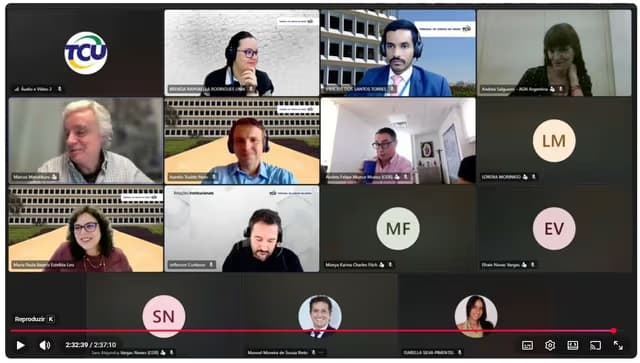
The Brazilian Federal Court of Accounts (TCU), through the Organization of Latin American and Caribbean Supreme Audit Institutions (OLACEFS) and its Citizen Participation Commission (CPC), held the webinar "Citizen Participation in Oversight: Experiences from Latin America" on 16 July, via its official YouTube channel. The online event aimed to foster technical dialogue and exchange of practical experiences in this field, contributing to the strengthening of the capacities of Supreme Audit Institutions (SAIs).
Opening the webinar, Manoel Moreira, TCU's Secretary of Institutional Relations and representative of the OLACEFS CPC Presidency (2026-2028), presented recent initiatives undertaken by the Court in this area, including the Citizen Participation Framework, published in 2025, and the Citizen Participation Portal. He emphasized that the meeting is part of the CPC's agenda to promote regional cooperation and facilitate the exchange of experiences among SAIs in Latin America and the Caribbean.

During the second presentation, Professor Marcos Mendiburu, international consultant on transparency and accountability, addressed challenges, progress and opportunities related to citizen participation in government auditing. He revisited historical discussions on the subject, such as the relationship between citizen participation and the independence of audit institutions, and demonstrated, based on data from the World Bank, that there is no correlation between greater openness to society and loss of institutional independence.
Professor Mendiburu also discussed current trends, including the fragmentation of strategies and the lack of external evaluations on the impact of civil society engagement. In addition, he proposed topics for the future of the Citizen Participation Commission, including consultation with civil society in the preparation of the next OLACEFS plans.
Monitoring Public Works
Subsequently, Silvia La Ruffa, Secretary General of the Presidency of the General Audit Office of Argentina (AGN), and Andrea Salgueiro, head of the institution's citizen participation department since 2002, presented Argentina's participatory planning model. They explained how the AGN incorporates recommendations from civil society organizations into its annual audit program and how it promotes workshops with civil society during the planning, implementation and submission of audit reports. The AGN currently maintains a network of over 300 registered organizations.
The third session of the webinar featured a lecture by Giovanni Rojas, Director of Regional Monitoring of the Delegate Department for Citizen Participation of the Office of the Comptroller General of Colombia, showcasing the "Saving Public Works" strategy, focused on the recovery of unfinished or stalled public infrastructure projects, with direct participation of civil society. According to the data in display, the strategy has already enabled the delivery of over 560 public work projects during the current management of the Office of the Comptroller General, supported by citizen oversight committees and georeferencing tools used to monitor works.
Self-Paced Learning Course
"In the fourth segment, Maria Paula Lins, Director of Citizen, Government and Public Sector Relations at the TCU, presented the Court's citizen participation strategy, structured around two pillars guiding the labor of the Department of Institutional Relations (SRI), namely Institutional Dialogue and Citizen Participation, and the guideline in charge of the General Secretariat for Government Audit (Segecex): Citizen-Centered Oversight, drawing on the levels of participation recommended by the Organization for Economic Cooperation and Development (OECD) - information, consultation and engagement." She detailed initiatives such as the Citizen Participation Portal, which has already gathered thousands of votes and reports from citizens through public consultations carried out by the TCU, and the Together for the Citizen Program (JPC), which combines guidance for municipal managers with civic oversight conducted by citizens.
Closing the event, Aurelio Toaldo Neto, Head of the TCU's Citizen Participation Service and representative of the CPC Presidency, thanked the speakers and participants and reinforced that the Commission's bimonthly meetings will continue to be held. He announced the collaborative development of a self-learning course on citizen participation involving CPC members and invited all SAIs, including those that are not currently members of the Commission, to contribute to this collective construction.
Watch the webinar here: Participatión Ciudadana en el Control: Experiencias de América Latina.