TCU Concludes Discussion Series on Multidimensional Poverty Audits
By Secom / Serint
The TCU's Audit Department for Social Security, Welfare and Labor (AudBeneficios), with the support of Department of International Relations (Serint), concluded an international series of technical discussions on multidimensional poverty audits. The initiative brought together experts and representatives from 12 Supreme Audit Institutions (SAIs) and international organizations to share experiences, methodologies, and challenges related to assessing public policies aimed at reducing poverty.
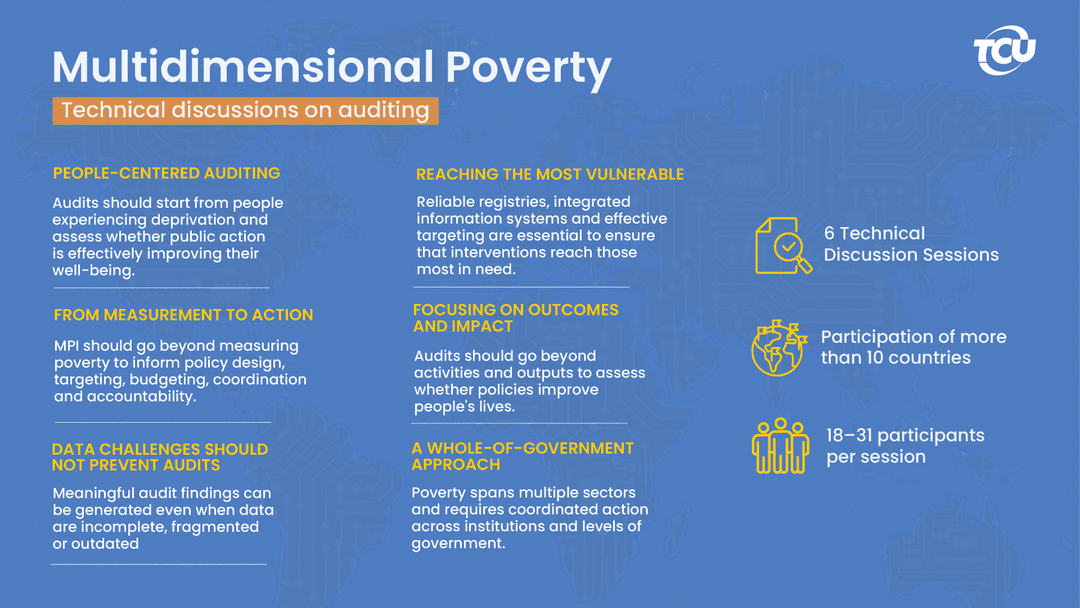
Over the course of six meetings, participants discussed indicators, evaluation methods, and strategies to measure the results and impacts of public policies. For the Brazilian Federal Court of Accounts (TCU), the series provided an opportunity to learn and keep abreast of innovative approaches, indicators, and strategies used in different regions of the world to assess the effectiveness and impact of public sector interventions.
The discussions explored in depth the Multidimensional Poverty Index (MPI), developed by the Oxford Poverty and Human Development Initiative (OPHI) and the United Nations Development Program (UNDP). The specificities of multidimensional poverty affecting children were also discussed, based on studies and evidence presented by UNICEF.
The meetings also addressed the Multidimensional Poverty Index for Latin America, developed by the Economic Commission for Latin America and the Caribbean (ECLAC) in partnership with UNDP, as well as initiatives led by the Organization of American States (OAS) to support governments in adopting this approach.
Representatives from Costa Rica, Egypt, India, Madagascar, Maldives, Thailand, Uganda, the United States, as well as the European Court of Auditors, exchanged practical audit experiences related to poverty, broadening participants' understanding of different institutional models, implementation challenges, and strategies for evaluating results.
Among the key learnings highlighted by participants were the importance of people-centered audits, focus on the results and impacts of public policies, the need to reach the most vulnerable populations, integration across different sectors and levels of government, and the use of evidence to support decision-making. Discussions also demonstrated that data limitations should not prevent the performance of relevant audits capable of generating valuable recommendations for public administration.
With the conclusion of this stage, the project now advances to the development of an International Guide on Multidimensional Poverty Audit, an initiative coordinated by the TCU within the framework of INTOSAI. The knowledge generated during the discussions will serve as the foundation for the development of practical guidelines to support audit institutions worldwide in conducting audits that apply multidimensional poverty measures, aimed at improving the living conditions of the most vulnerable populations.